
When Politics Enters the Exam Room: A Conversation with Bex on Puberty Blockers, New Zealand, and Clinical Responsibility
Feb 25, 2026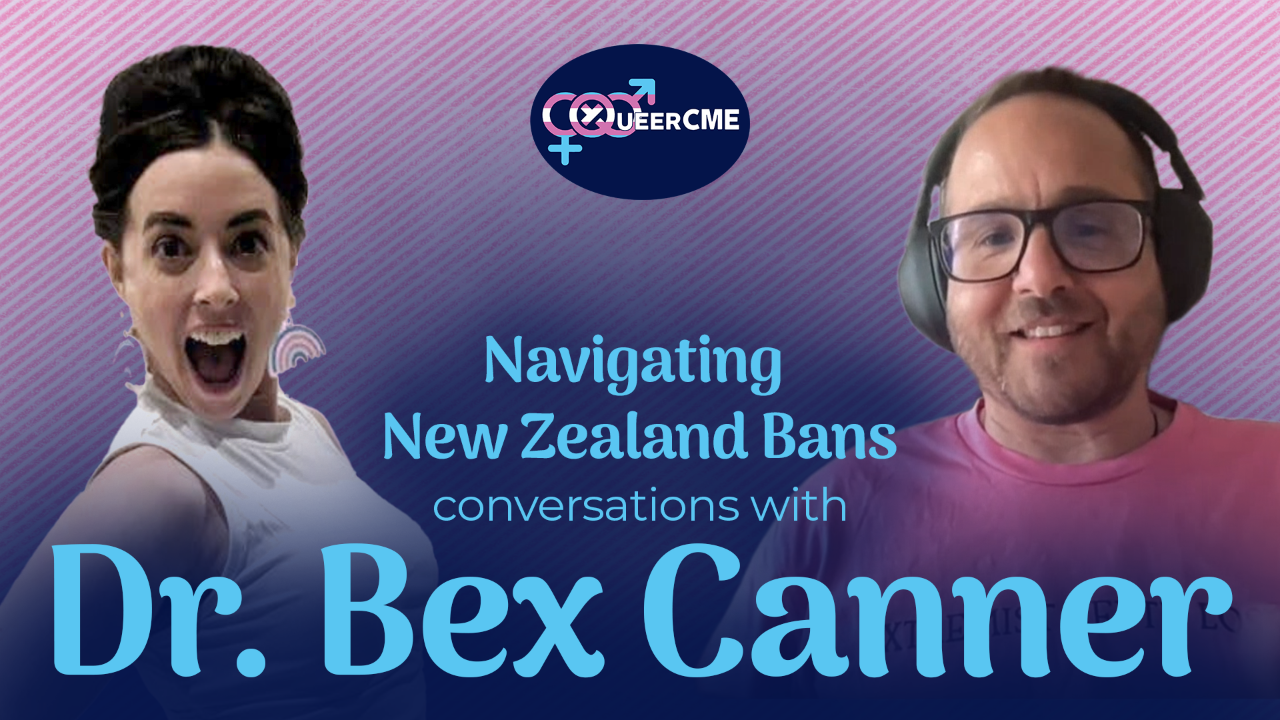
Bex is not just a guest on our podcast.
Bex is a local advocate in Aotearoa New Zealand who has been living — and organizing — at the intersection of medicine, policy, and community survival.
In our recent conversation, we explored the recent political efforts in New Zealand to restrict access to puberty blockers for trans and gender diverse youth. If you practice in the United States, this may feel familiar. If you practice anywhere else in the world, it should still concern you.
Because what is happening in New Zealand is not isolated. It is part of a coordinated global strategy: insert political oversight into the provider–patient relationship, misrepresent the science, and create fear where evidence already exists.
Puberty blockers — gonadotropin-releasing hormone analogues — have been used safely in pediatric endocrinology for decades. They are standard treatment for central precocious puberty. In gender affirming care, their use for adolescents experiencing gender dysphoria or gender incongruence is well described in both the 2017 Endocrine Society Clinical Practice Guideline and the 2022 World Professional Association for Transgender Health Standards of Care Version 8 . These guidelines acknowledge the need for multidisciplinary care, careful assessment, and ongoing monitoring — not political veto power.
And yet, in New Zealand, politicians have proposed restrictions that frame this care as experimental or dangerous, despite decades of endocrine data and growing longitudinal research.
This is the move. Rebrand established care as radical. Replace clinical nuance with soundbites. Suggest “protection” while undermining autonomy.
Bex helped us understand something critical: local advocacy matters.
When national politics shift, it is local clinicians, parents, youth, and community members who mobilize first. It is local providers who testify. It is local researchers who clarify data. It is local organizers who translate fear into strategy.
If you are a prescribing clinician, you may feel like politics is something happening “out there.” But the minute legislation begins dictating what you can or cannot offer a patient — based not on evidence, but on ideology — the political has already entered your exam room.
The 2017 Endocrine Society guideline recommends puberty suppression for adolescents who meet criteria and have entered early puberty . The SOC-8 continues to support puberty suppression within a patient-centered, multidisciplinary model and emphasizes flexibility and informed decision-making . Neither document suggests that politicians are better equipped than clinicians and families to determine appropriateness of care.
What Bex named clearly is this: misinformation spreads faster than journal articles.
Opponents of gender affirming care rely on three tactics:
-
Cherry-picked or misrepresented data
-
Emotional narratives detached from epidemiology
-
Framing clinicians as reckless rather than cautious
If we want to combat this, we cannot simply say “trust the science.” We have to know it. We have to understand study design, limitations, risk modeling, and absolute versus relative risk. We have to speak clearly about what we know — and what we are still studying — without defensiveness.
Because here is the truth: evidence-based care for trans youth is not perfect, but it is real. The risks of treatment are monitored and manageable. The risks of withholding care — depression, suicidality, family rupture — are not theoretical.
Politics thrives on ambiguity. Good medicine clarifies it.
One of the most powerful moments in our conversation with Bex was the reminder that advocacy is not separate from clinical care. It is an extension of it. If your patient’s access to evidence-based treatment is threatened by policy, neutrality is not apolitical — it is alignment with the status quo.
Local advocacy can look like:
– Writing op-eds grounded in data
– Testifying when legislation is proposed
– Supporting medical societies in issuing position statements
– Educating colleagues who are confused but persuadable
– Staying clinically sharp so misinformation cannot take root
You do not have to become a full-time activist.
But you do have to decide whether you will let politicians define your scope of practice.
At QueerCME, we believe curing trans healthcare discrimination requires more than prescribing correctly. It requires understanding how white supremacy, colonialism, and paternalism show up in health policy. It requires knowing the literature well enough that you can calmly dismantle misinformation in a hallway conversation or a committee meeting.
Bex reminds us that this work is global. What happens in New Zealand echoes in the United States. What happens in the UK influences policy in Australia. None of us are practicing in isolation anymore.
If you felt anger listening to this episode, good. If you felt fear, that’s understandable. But the antidote to both is competence.
Know the guidelines. Know the physiology. Know the risk data. And know that protecting the provider–patient relationship is not political extremism. It is ethical medicine.
We are not here to be neutral about evidence-based care.
We are here to raise the bar in queer and gender affirming healthcare — and to defend it.
SUBSCRIBE FOR MONTHLY UPDATES
QueerCME distriputes a monthly newsletter which details our content updates. We also offer free live stream didactic sessions on topics in gender affirming healthcare, so we send out reminders around those as well.
We hate SPAM. We will never sell your information, for any reason.
